

℟. Déxtera tua magnificáta est in fortitúdine, déxtera tua confrégit inimícos:
* Submérsi sunt in aquis veheméntibus, et opéruit eos mare.
℣. Benedíxit te Dóminus in virtúte sua, quia per te ad níhilum redégit inimícos nostros.
℟. Submérsi sunt in aquis veheméntibus, et opéruit eos mare.
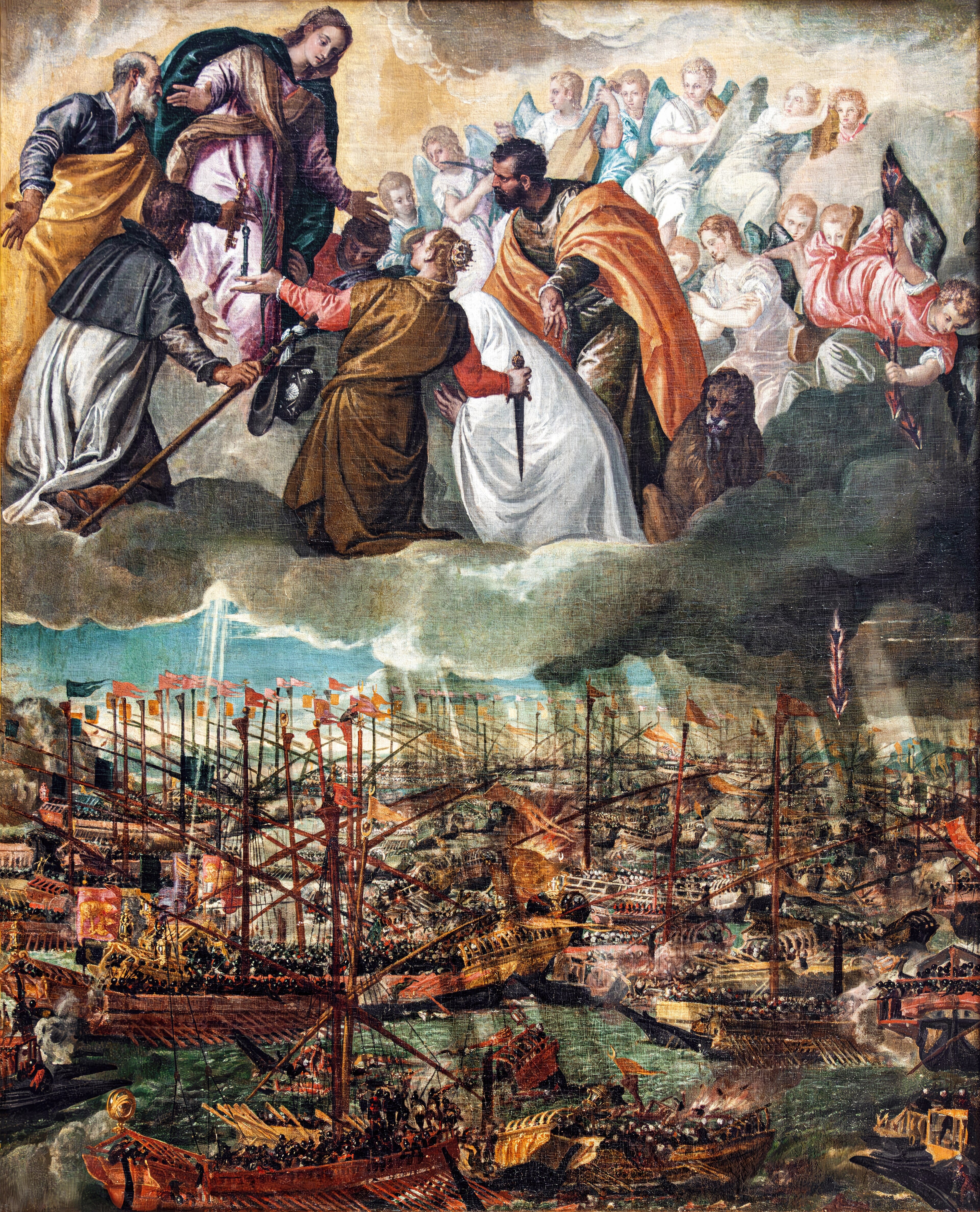
Today, October 7th, in 1571 the forces of Pope Pius V and the Christian princes defeated the Sultan of Turkey in what remains the largest naval battle since antiquity. Across Europe that day, the members of the Sodality of the Rosary united their prayers to Our Lady, and as a result the Church recognizes today as the feast of Our Lady of the Rosary.
The forces of the Holy League did not have certainty that their fate was secure in the hands of the Lord. The League was fractious and nearly fell apart before the battle and Venice had just lost Cyprus. While Europe was in confusion, the men in battle did not concern themselves with these problems. Chesterton, in his poem Lepanto, places great emphasis on the willingness to act, present in the crusader spirit. The allegorical Muhammad fears the man described as “he that saith not ‘Kismet’; it is he that knows not Fate.” The enemy recognizes this type of person as especially powerful, someone who will keep acting when the rest of the world has accepted how things must go. An apparently inevitable future has the power to exert prophetic authority over the present. Once one is resigned to his fate, he often regards opposition as foolish and irresponsible. Chesterton’s figure refuses that surrender; he exerts his true freedom to judge what deserves his allegiance. Christendom and its future still leave this man with something to do.
The traditional breviary’s lesson for the feast puts this courage into religious terms. In extolling the fruits of the rosary, it names “that great victory over the Sultan of Turkey, which the most holy Pope Pius V, and the Christian Princes whom he had roused, won at Lepanto.” Here the victory is not only attributed to the Pope and the Holy League but also God’s great mercy, besought through prayer.
The lesson also describes the “accustomed prayers and appointed supplications” of Christian brethren. The common form and rhythm of the rosary united Christendom toward spiritual and secular victory. Christians understand that action and victory require a recognition of dependence on God. Our language, skills, and loyalties have too been inherited from our ancestors. Prayer combines thanksgiving for the gifts we have been given and then petitions the Almighty to further assist us in a world we cannot wholly command. It also leaves us still responsible for the decisions and work required.
The breviary illuminates the refusal of fate we read in Chesterton. Trust in providence does not require us to identify the fortunes of whatever political power is ascendant with God’s will. Christians can ask for deliverance when circumstances are bleak and the future does not seem on their side. They can also ask for the strength to act, through the virtue of their hope.
The rosary at Lepanto stood beside the arsenal of war. It required ships and thousands of men and was materially expensive. The obligation to preserve the inheritance of Christian Europe can require new instruments. Where Lepanto was fought with the capabilities of its age, their example shows us how imperative it is to bring about new inventions and skills. The Venetian galleasses, heavily armed ships that broke up the Ottoman line, were the new technology of that battle. So was the Venetian Arsenal’s mass production of ships. The continuity we seek has to be sustained by unfamiliar work.1 Just as our families must pray, so too must our men be trained and our knowledge increased. Religious conviction only heightens the gravity of these duties.
Chesterton’s heroic poem hails the victory with cheers for Don John of Austria. The breviary shows us another way to give “unceasing thanks” for the “extraordinary mercy of God.” The responsory following the reading uses the language of deliverance at sea:
℟. Thy right hand is become glorious in power; thy right hand hath dashed in pieces the enemy
* They sank as lead in the mighty waters, and the sea covered them.
℣. The Lord hath blessed thee by His power, because through thee He hath brought our enemies to nought.
℟. They sank as lead in the mighty waters, and the sea covered them.
The Church remembers the battle through thanksgiving both due to the Pope who roused the princes and the men who went to war, while its praise acknowledges a power beyond theirs. In the liturgy, the “thee” is Our Lady, with Judith as her type. We are reminded that in His incarnation God became man and acted through a human intercessor.
On this feast of Our Lady of the Rosary, we give thanks for a deliverance that once had to be sought. Our own circumstances will require disciplined preparation and courage and may demand we endure failure, but the feast shows us a way to undertake them with hope.
Thanks be to God.
This has been recognized by those in the Reindustrialization movement.