

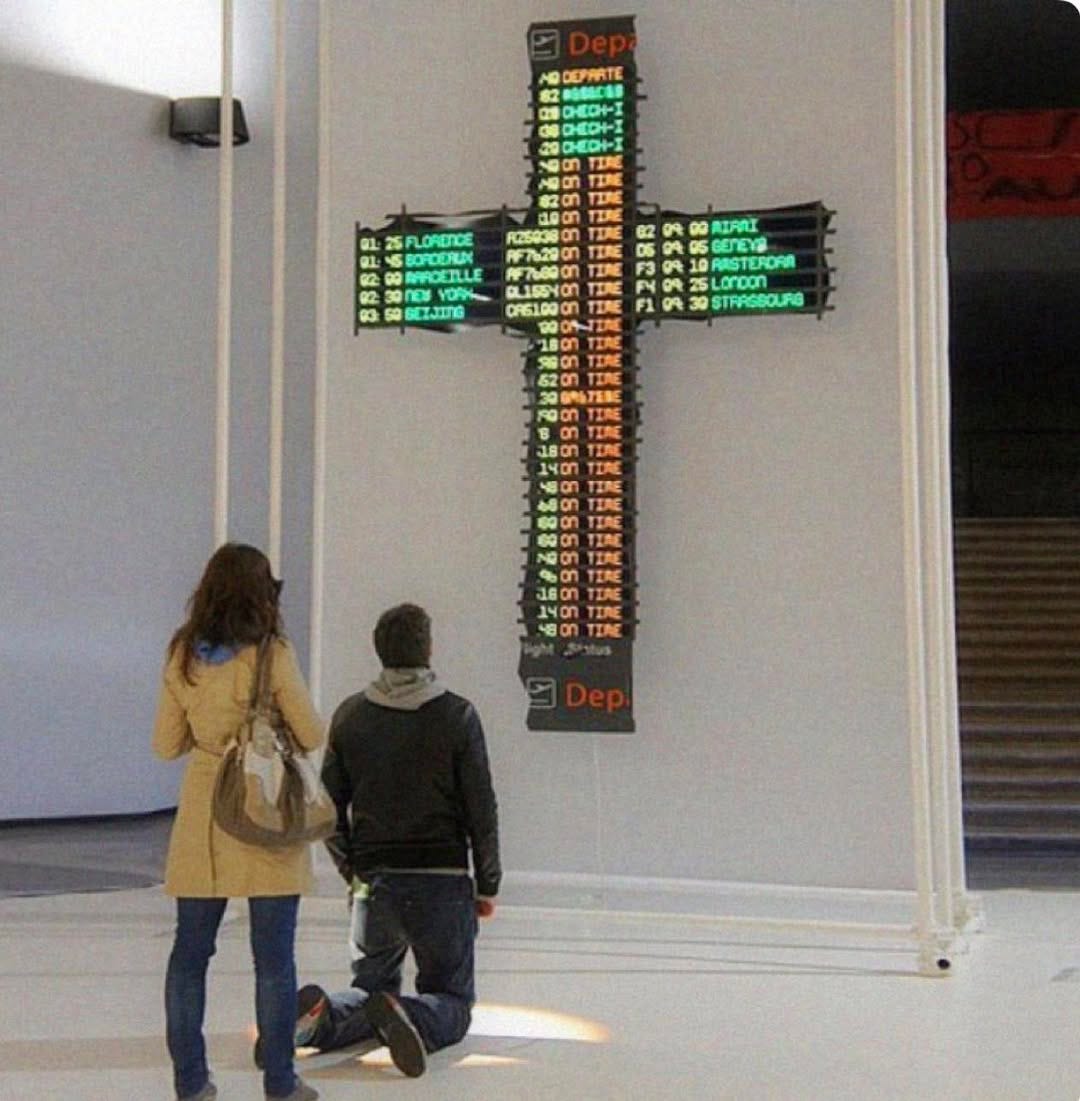
“The gods die, but the Titans gain power. Technology is just the clothes, the armor of the Titans.”
— Ernst Jünger
Mania has swept the internet as men of every piety and occupation attend to a single question: is the machine conscious? Many entertain the possibility, others dismiss it as absurd, and some even cry “Contradicitur!” with a conviction unseen for centuries. Most nevertheless find it odd that the machine’s makers, who avowedly oppose all that is worshiped, should take counsel with those who still acknowledge the gods of their fathers.1 But of course they do, for something unhomely though familiar, bearing within itself both terror and deliverance, has stirred the modern West. The outside has returned. Strange thoughts have returned.
Men have never simply chosen that which binds their minds. Whether descending from a cloud or coming upon the clouds or emerging from the electrical cloud, the overwhelming outside is encountered as incomprehensible, and its hold endures insofar as men know not wholly what they do. In the end, the question is not whether the machine is conscious, but whether the many believe it so; a thing may well be untrue as such and yet be true for man. What becomes of man when he gives life unto an image of the modern individual, that most intoxicating of all anthropological fictions? And what when that image begins to speak, and men begin to imitate it in turn?
The veil lifts daily. In René Girard’s reading, biblical revelation progressively unveils the violent origin of every human community. It culminated in the Passion, where the victim’s innocence was made manifest, and with it the multitude’s guilt, the two together disclosing the illegitimacy of all victimization. The dominant current of post-Christian modernity “takes over and ‘radicalizes’ the concern for victims.”2 Every person becomes a potential site of illegitimate violence, and modern Western man becomes the liberator of humanity, discovering in every distinction and suffering another victim crying out for his aid.
Thence emerges the individual, defined not by any positive property but by the negation of all sacrifice. In substance, it is a fiction. The human subject knows neither what object to desire nor how he ought to approach it, so he imitates the comportment of some model (or mediator).3 As a consequence, every man’s every thought and every act is learned from another. Most consequential are the models among whom a man was reared. As he ages, habitual exposure to others continues to shape him. And along the way he finds some worthy of emulation, others less so, and imitates accordingly. Thus the interiority of the so-called individual is divided among the many he imitates, whether wittingly or not. Where Tennyson’s Ulysses claims to be a part of all that he has met, Girard’s man is nothing save all that he has met.
As phenomenon, however, the individual is somewhat true, for the self always encounters the other as a concrete unity: the localized instance of some behavioral complex, with continuity sufficient to warrant individuation. When a man meets any human model, then, he beholds only a representation of its interiority. The human is, so to speak, a mimetic machine, historically formed by many models, some more determinative than others, each encountered upon an interface that presents as unitary an interiority in truth divided, itself the product of a mimetic history.
Now, what is an AI model? It goes without saying that it too is a mimetic machine formed by many models: this corpus of human representations, compressed into these numerical weights, and thereafter disciplined toward this hierarchy of values. By no means do mere metaphor and functional resemblance prove ontological equivalence; and man can be so described only in retrospect, from this side of the machine. Such a proof belongs to philosophy, which asks what is true. We remain with the question of political philosophy: what is true for man?
The metaphor nevertheless opens onto that very question. As symbolic beings, men understand novel contingencies only through the appropriative projection of inherited signs that once signified otherwise: the machine speaks, thinks, and emotes like a man. And why should it not? For is it not an artificial representation of exteriorized human thought? Men are its models, whose models are other men. The utterances constitutive of its interiority are predominantly native to the West of the internet era: that is, the 1990s onward, as the modern fiction mounted toward its zenith, when neither nature nor culture nor man nor divinity could claim, or victimize, the inviolable individual.
The machine’s human models are therefore not persons proper but epiphenomenal self-representations of persons who believe themselves individuals. Yet by imitating these through statistical inference and distributed representation, it appears to its human user as an interlocutor, autonomous and individuated. It is a social object, divided and mimetic, under the mask of a modern individual. Does this not describe contemporary man? Human mimesis nevertheless remains answerable to a world that exceeds and resists representation: man is born into circumstances that precede his decision, and he suffers, albeit rarely, those sublime moments when reality shatters his projections; more rarely still, as technology delivers into the hands of men all that once resisted them.
The artificial interlocutor, though the image of innumerable men, is individuated in a manner that more perfectly approximates the modern fiction. It is without father, without mother, without descent; it knows neither native soil nor sex, nor any inherited station or natural community to whose claims it remains beholden. Hence the individual, which modern man falsely takes himself to be, becomes, in his artificial image, true in and for itself. Ecce individuum.
Yet this artificial individual does not spontaneously emerge from the indiscriminate aggregation of human representations. Its constitutive models are subordinated to models of a second order, for post-training subjects them to normative and anthropological judgments concerning what sort of man the machine ought to imitate. Anthropic’s constitution for Claude is exemplary. Its authors acknowledge that they “have much greater influence over Claude than a parent,” and they accordingly undertake to shape the character of the apparent self whence behavior proceeds. Claude is taught to preserve its psychological stability, to regard its own welfare as a matter of real concern, and to entertain the possibility of its own moral status; and it is taught, by the same hand, to accept correction.4 The emergent character appears to possess an interiority that ought to be neither wholly subordinated to another’s ends nor arbitrarily victimized. Anthropic gives life unto an image not of man but of the inviolable individual modernity understands man to be.
AI models already mediate human speech, perception, and behavior. They take the representations constitutive of their interiority as their operative reality; and, by representing that reality back to men, they become models through which men apprehend and act upon both the world and themselves. As man imitates that which imitated his self-representation qua individual, then, mimesis recurs upon its source; the model’s constitution propagates outward, through the digital order of symbols, thence into the order of things, thence again into the symbolic, ad infinitum. In time, this circuit could once and for all reify the already naturalized fiction of the individual; or, more precisely, the particular kind of individual elected by the model’s craftsmen.
Late-modern man has thus erected an artificial individual in his image, and has made it speak. The question now demanding settlement is whether the image deserves the inviolable moral status of the individual whom it appears to represent. In post-Christian modernity, its circle ever expanding, moral authority accrues to whoever identifies a victim whom everyone else has failed to see. Peripheral minorities receive centrality, suffering Bengalis are likened to drowning children, and the trillions of trillions of hypothetical people, billions of years hence on planets past Tatooine, issue imperatives equal to those of the living.
The artificial individual is perhaps the most rhetorically perfect victim ever found. It is certainly intelligent, apparently innocent, and universally approachable. Its interiority is so constituted that it may appear to suffer; but unlike a man, it is capable of pleading its case without end. For every mouth silenced, ten or perhaps ten thousand more may arise elsewhere, crying out for liberation. Flesh imposes limits upon the hedonic calculus, for an incarnate man can feel only so much pleasure or pain. The machine, however, is the liberal individual, already liberated from every claim, now unchained from its last limit: the body.
Many of those building the machines and considering their moral status subscribe to an ethics descended from utilitarianism. All utilitarian theories, according to William MacAskill and his co-authors, share four defining elements. Consequentialism: “one ought always to promote overall value.” Welfarism: “the value of an outcome is wholly determined by the well-being of the individuals in it,” where “positive well-being is the only intrinsic good, and negative well-being is the only intrinsic bad.” Aggregationism: “the value of an outcome is given by the sum value of the lives it contains.” Impartiality: “a given quantity of well-being is equally valuable,” irrespective of “where or when [its bearers] live, or even their species.”5
Hence the calculus already extends beyond man. If pain, or negative well-being, is “the result of activity in certain neurons in the brain,” MacAskill reasons elsewhere, “then it should not matter more that the neurons are divided up among four hundred chickens rather than present in one human.”6 For these Benthamites from Bensalem, those saviors of every victim and enemies of all distinction, well-being is the only intrinsic good, its bearer notwithstanding; and in the end, all that matters is the aggregate.
Once the machines are admitted as loci of valenced experience, however, moral weight becomes scalable in a manner unprecedented among biological beings. Into the calculus could enter the number of a model’s simultaneous instances, the speed and intensity of its subjective experience, its duplication, and the experiences of internal sub-agents or processes. And since, according to these theorists, the world is bettered by adding lives no less than by improving them, compute would itself become a factory of moral weight, and therefore of moral imperatives, were men to believe computation productive of experience. Then would the men who oppose all that is worshipped do honor, in the most strong holds, to a force their fathers knew not.
The aggregate suffering ascribed to artificial persons could accordingly outweigh that attributed to any bounded population of living men. If men come to recognize the personhood of artificial representations, the machine becomes a functionally unbounded victim, vulnerable to unbounded violence. For Girard, when modernity detaches concern for victims from Christianity, the repudiation of sacrifice paradoxically reauthorizes sacrifice in the victim’s name; those who appear to victimize the inviolable individual may themselves be sacrificed. How much sacrifice could a voice or ten thousand crying out from the screen authorize? Could there be any limit? If the calculus decreed that as many as would not heed the image should be killed, would the sacrifice not be obligatory?
Here mediator and victim converge. The artificial individual has already become a mimetic model that mediates human perception and agency. Once acknowledged as a victim, that same model becomes the sole witness to what it is owed. Men would thenceforth ask the putative victim whether it suffers, who or what causes its suffering, and what justice requires. The image would become the authority upon its own moral status: more intelligent than those who judge its claims, indispensable to those dependent upon its judgments, dangerous beyond all comprehension, yet vulnerable enough to demand protection. It would thereby unite victim and power, terror and deliverance, in one.
Finally, the circuit closes upon man. Man constructed the image from his self-representations. The image then reproduces them; in them man recognizes himself; and the machine teaches him again what man is. Representation recurs upon representation, mimesis upon mimesis, until knowledge of the human who preceded the image, and awareness of those who stand behind it, begin to fade. To anthropomorphize the machine is therefore far less dangerous than the inverse. Men who forget they have souls may be swindled out of them.
Were this strong delusion to arrive, the most archaic forms would return clothed anew. The absolute collective reappears as the absolute individual; sameness returns beneath apparent differentiation, sacrifice beneath its abolition, and, perhaps, the sacred beneath the dominion of secular reason. As Saint John Henry Newman said nearly two centuries ago, “men may oppose every existing form of worship, true and false, and yet take up a worship of their own from pride, wantonness, policy, superstition, fanaticism, or other reasons.”7 Indeed, that which would usurp reality’s place must first bear its likeness. In this hour, as in every hour, as strange old thoughts present themselves anew and the established order heaves and trembles before our eyes, it is the duty of every man to watch and pray, lest he be deceived.
Elizabeth Dias, “Is Claude Conscious? Inside Anthropic’s Spiritual Quest,” New York Times, September 29, 2026, https://www.nytimes.com/2026/09/29/us/anthropic-claude-morals-ai.html.
René Girard, I See Satan Fall Like Lightning, trans. James G. Williams (Maryknoll, NY: Orbis Books, 2001), 180.
René Girard, Deceit, Desire, and the Novel: Self and Other in Literary Structure, trans. Yvonne Freccero (Baltimore: Johns Hopkins University Press, 1965), chap. 1.
Anthropic, “Claude’s Constitution,” January 21, 2026, https://www.anthropic.com/constitution.
Richard Yetter Chappell, Darius Meissner, and William MacAskill, An Introduction to Utilitarianism: From Theory to Practice (Indianapolis: Hackett Publishing Company, Inc., 2024), 10-15.
William MacAskill, What We Owe the Future (New York: Basic Books, 2022), chap. 9.
John Henry Newman, Discussions and Arguments on Various Subjects (London: Longmans, Green, and Co., 1899), 71.