

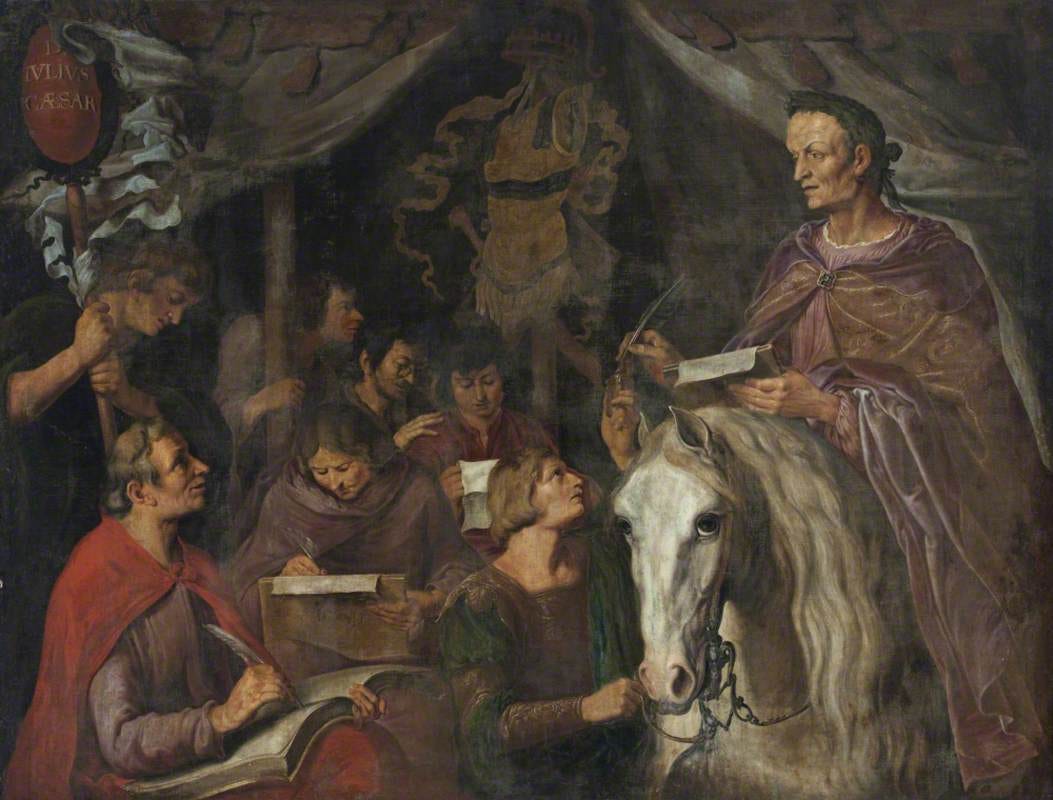
If you are not familiar with the basic facts of how Julius Caesar became the first man in Rome, then you are probably not on X these days, and we pray you are the wiser for it. Now is probably a good a time to fix that deficit. There are many books, Plutarch’s biography of the man is a good place to start. Or for the audio-inclined, let us suggest the Cost of Glory podcast series on the man and his wars. Here however, we present some less-noted yet crucial ingredients of his victory.
First, Caesar built a parallel power structure, a parallel operational team, one which stood outside the control of the Republic’s traditional institutions, and was in some way illegible to it. By the time he won the Civil War, he had in his entourage many talented military men, personally loyal to him. But he also had many men with other skills: helping him keep up his massive correspondence, keeping tabs on important people. There was significant overlap between these two groups; but the important fact to emphasize is that the apparatus that helped him win the Civil War was also largely the one he used to govern after he won it.
The core were mostly younger men, say in their late 20s or 30s. They could write legislation for him, listen to what was being said amongst the poets and tastemakers, the moneylending classes, the government contractors, the soldiers, and the key men in the senate. They were not just “keeping tabs,” in a surveillance capacity, but also making these people feel heard and appreciated, advising them on what the Dictator would like to see happen. Hirtius, Balbus, Trebatius, and Oppius, to name a few.
The aged orator Cicero is a good example of the sort Caesar was trying to attract, a sometimes adversary, sometimes friend for much of Caesar’s career, who “fought” on Pompey’s side in the Civil War, but made peace with Caesar after the first decisive battle at Pharsalus (the war dragged on several years after that - there were hardened holdouts).
Caesar built his independent power structure over years of campaigns, both against the Gauls and against Romans, and when he won and decided to run the Roman state in a radically different way, he already had the machine in place to do that. Notably, he built this power structure not out of big names with big fortunes, but overwhelmingly on merit. Caesar was successful because he found real talent that was overlooked or shut out by the oligarchy. He forged and tested their loyalty, to him and to each other, through risk and conflict.
Not accidentally, the ruling apparatus Augustus used to make the victory permanent was very much built from the pieces Caesar assembled.
It is good to keep in mind therefore, while one is fighting battles within the established legal and political framework, that any strong relationships built across different departments, across the private/public divide, the civil/military divide, might themselves constitute some of the most enduring achievements undertaken. Look especially to invest in those relationships which could outlast the incentive structures of the current circumstances.
Secondly, it is worth studying how Caesar leveraged cultural power, both to win his hot civil war, and to put the pieces of the ruling elite back together once he won (the same can be said about Augustus).
Even while he was still fighting his war in Gaul (58-51 BC), before the Civil War of 49, Caesar was keeping up correspondence with the leading literary figures of Rome, such as Cicero and Catullus; he was reading the latest speeches and literary works, like Lucretius’ Epicurean poem On the Nature of Things. Caesar was writing treatises on good Latin style, “practically as the Gallic spears were flying about him,” as Fronto later wrote.
Caesar appreciated the finer things. He was fashionable! classy! a tastemaker in the Roman artistic scene! He did enjoy this, to be sure; but why would a serious man, with the appetite for work Caesar had, take the time out of his busy schedule to do it?
One reason is that he wanted to give the Ciceros of the world the confidence, the permission, to get behind a tasteful, reasonable guy, tasteful, reasonable gentleman. It gave the sophisticated types a sense that, if and when he came to power, the good life as they had come to understand it was still going to be possible (mostly at least). Cultural power is real power. Especially prestige cultural power: it is a matter of public opinion, yes, but prestige culture is especially about elite opinion. You need to gain approval from some of these people in order to win, and you need even more of those people on board in order to run the huge ship once you take control of it. Thus, cultural power is worth fighting for with the same level of will and craftiness as other forms of power.
Caesar knew he was not going to win over everyone with this cultural bridge building. Before and during the Civil war, his enemies kept calling him a Tyrant In Waiting who wanted to overthrow the State. But just because some people call you such things, it doesn’t mean the strategy isn’t working: quite the opposite. Caesar didn’t let such chatter frazzle him, but instead calmly maneuvered to make them look silly to the moderates—in part, by being reasonable and high-class in a very public way.
This laid the groundwork for the reconciliation after he won. Of course, we all know Caesar was assassinated by men he spared and worked to reconcile, like Brutus and Cassius. (Perhaps he played a little bit too nice). But this should not cloud our appreciation of the fact that Caesar’s reconciliation mostly worked: the conspirators excluded Cicero from the assassination plot, precisely because Caesar had pacified him so thoroughly, and rendered him unreliable for the purposes of the coup. The coup ultimately failed, remember: the principate was eventually established in the name of Caesar. Cicero’s political wisdom, arguably, could have made it succeed (he would have voted for killing Antony too, which would have sealed it). Thus, Caesar (or his ghost) won. And he laid the groundwork for his reconciliation by seizing cultural power.
Augustus too is a great example of this: before he won his final victories against Antony, he was already building relationships with poets and tastemakers, especially through his childhood friend and cultural attaché, Maecenas. The result is some of the best poetry in the Western tradition, from men like Horace and Virgil; when Augustus became princeps, these loyal artists were crucial for helping the Romans come to terms with a new vision for their state, consoling themselves for the occasional political frustration by the enjoyments of a new golden age of peace and high art. (See the Georgics, the Aeneid).
This does not mean you should be distracted playing nice with people who hate you and want you dead. You actually have to win, decisively, firmly, before you can even think about reconciliation. Caesar also controlled virtually all the relevant security forces by the time he started pardoning people.
But before the decisive (peaceful and Democratic) victory, you can lay the groundwork for ruling by doing quality friendmaking and building cultural capital at the very same time. You can have fun doing it, too (in fact, that is the only way to do it).
In 479 BC, a small, tight-knit group of Theban exiles sneaked into their own city, which was under a Spartan garrison and controlled by pro-Sparta oligarchs. They assassinated the oligarchs, rallied the people, and managed to expel the foreign garrison under a truce. (Read Plutarch’s Life of Pelopidas and De Genio Socratis; see also the Cost of Glory series on Agesilaus). But how did they become “tight-knit”? In fact, they met in private homes in Thebes and Athens to discuss philosophy.
When Brutus and Cassius were recruiting for the assassination plot, they had a series of dinners to discuss philosophy. In reality, they were using such philosophical conversations to subtly gauge potential conspirators’ willingness to do the deed (many were rejected in this way without ever knowing they were candidates). All this would have been awkward or impossible if it weren’t already a well-established habit.
“Cultural activities” can offer these outlets: “safe spaces” for men to get together, offline, unrecorded, enjoy good conversation and debate, refine their wit, build and test relationships. Many such projects exist already—if you can’t already name a few, ask around. Book clubs are one model; another is the Private men’s only debate club: a context where one can hone persuasive skills and build consensus; such clubs can also host public debates, which are a great way to air many moderate centrist views to amenable audiences, and project reasonableness and sophistication to tastemakers and powerbrokers. America used to be filled with such institutions. Why did they vanish?
The Classics (even broadly construed) are promising subject matter for such gatherings: as the Romans recognized, classical traditions are by definition firmly situated in the cultural high ground. And the Left-controlled establishment institutions have basically forfeited this territory (at least in the eyes of energetic men). Rightly understood, books worthy of the name “classics” also constitute a library of manly excellence, political wisdom, persuasive examples, and convincing metaphysical depth—just the sort of things we need most today. Good men should seize them, and leverage them as a rallying point to build parallel structures, sharpen wits, and lay the groundwork for the grudging acceptance of a bright future.

Excellent piece.